
The editorial
Everything discussed so far about Türkiye’s fund crisis has been on the victims’ side: 130 funds placed into liquidation, seven portfolio management companies closed, TRY210 billion in net outflows since 28 August, assets under liquidation put at between TRY826 billion and TRY891 billion, and close to half a million investors unsure when, or how much of, their money will return. The Capital Markets Board extended the liquidation period from three months to six, citing the need to sell assets under “appropriate market conditions”. Translated into plain language: these securities have no real buyer.
This is the accounting of losses. The accounting of gains has never been done.
The lesson Salgado taught is not the one you think
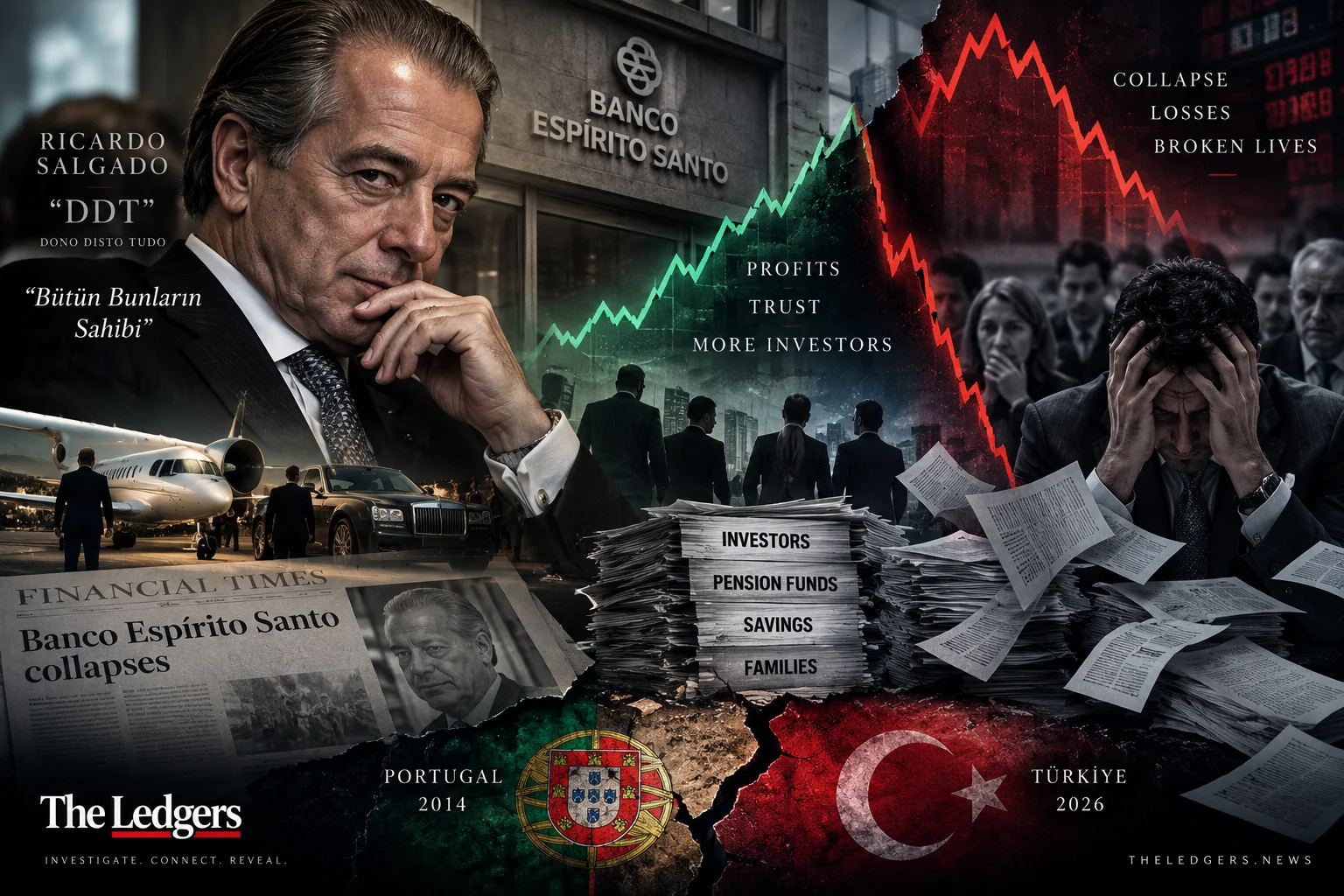
When Banco Espírito Santo collapsed in Portugal in 2014, the country already knew Ricardo Salgado by a nickname: DDT — “Dono Disto Tudo”, or “The Owner of All This”. The press had not invented it; it came from within the family. He really did see himself that way.
Salgado was not a bad banker. A bad banker miscalculates risk. Salgado calculated it perfectly well — he simply assigned the risk to the customer and the profit to the family. The bank’s treasury had become a credit tap for failing companies within the Espírito Santo group. At the counter, people arriving to deposit their pensions were sold securities issued by group companies, already known behind the scenes to be losing value, as though they were “safe deposits”.
Deloitte’s 2015 audit report gave this a name: “intentional acts of ruinous management”. The same report found that management had failed to comply with instructions from the Bank of Portugal 21 times between December 2013 and July 2014. Twenty-one times. That is not a series of mistakes; it is a method.
Salgado did not pay the bill. The bank rescue cost €4.9 billion. Shareholders were wiped out, small investors who bought the securities were burned, and public funds covered the gap. Salgado, meanwhile, spent years in court proceedings invoking age and ill health; his six-year prison sentence in the Marquês case was not upheld by the Supreme Court until June 2024. Ten years after the collapse.
That is the real lesson of the Salgado case: in structures like these, the moment of collapse is not the moment of the robbery. The robbery took place years earlier, while everyone was making money and account statements were still green. The collapse merely reveals who will be left with the bill.
How the mechanism worked in Türkiye
The emerging picture is not technical. It is, in fact, very simple.
A fund takes a large position in a thinly traded stock. A large buyer in an illiquid stock pushes the price up. As the price rises, the fund’s returns begin to shine. Those returns attract new investors through advertising, screenshots and headlines declaring that “this fund returned 300%”. The new money goes into the same thinly traded stock. The price rises again.
This is not an investment strategy; it is a loop consuming its own tail. It requires just one condition to keep working: incoming money must always exceed the money seeking an exit.
The figures bear the traces of that loop. Pusula funds held 25.59% of Katılımevim (KTLEV); the stock had risen more than 300% since the beginning of the year. The same funds had reached a 38.67% holding in Gündoğdu Gıda (GUNDG), where the increase exceeded 140%. Tera funds, meanwhile, held 39.41% of the free float of Destek Finans Faktoring (DSTKF).
When a single fund family holds forty per cent of a stock’s free float, the price on the screen is not a market price. It is a sentence that the fund is saying to itself.
Pusula announced a default on 15 September. Tera did the same on 16 September, and the BIST 100 fell by more than 5%; redemption requests reached $1 billion in a single day. On 19 September, the Capital Markets Board suspended trading in all funds of seven companies. Criminal complaints were filed against 38 people on suspicion of market manipulation; senior Tera Portföy executive İbrahim Bekçi was detained, his licences revoked and a two-year trading ban imposed.
The real question: who was on the other side?
Nobody is asking the one question that matters:
Who sold at the top?
Because when a stock rises 300% and then collapses, some people lose money along the way and others make it. The small investor inside the fund is the loser — we know that. Nobody has yet said who stood on the winning side.
As in the Salgado case, the answer will be found not in balance sheets but in the map of relationships:
01 — Who owns the companies in which the funds concentrated their positions? Do those people have business, family or shared-company links with the owners and managers of the portfolio management companies?
02 — While the funds were buying, did founding shareholders and managers sell their own shares? If so, at what price and on what date? This information can be established from Public Disclosure Platform filings and shareholder registers.
03 — As prices inflated, did these companies carry out cash capital increases? In other words, did they raise cash by selling new securities to the market at inflated prices?
04 — Were the inflated shares used as collateral for loans somewhere? If so, who took out those loans and where was the money spent?
05 — Who received the consultancy, brokerage and management fees paid by the funds to portfolio management companies?
The answers to these five questions replace “the money evaporated” with a list of names.
A final word
For the system to collapse in Portugal, Salgado did not need to be ill-intentioned; being sufficiently powerful was enough. It collapsed because nobody could say “no” to him, because nobody exercised oversight, and because nobody asked questions while everyone was making money.
In Türkiye, too, the question should not be “which fund failed?”
Where did the money go, whose pocket did it enter, and who was there when it left?
In the Salgado case, the answers emerged through a network of connected companies — but ten years later, after everyone had lost their money. Türkiye does not have to lose those ten years. The records remain: Public Disclosure Platform filings, fund portfolio reports, shareholder registers, land records and commercial registers.
They remain out of sight not because nobody reads them, but because nobody puts them side by side.
Source documents
00No source links were supplied for this analysis.
File updates
Investigation ongoing
Editorial research status recorded.
Report published
Editorial note
Comparative analysis supplied by The Ledgers Research Desk. The comparison does not establish a direct connection between the Portuguese and Turkish cases. The submitted manuscript contains no source links; the figures and legal developments have not been independently verified during preparation for publication.
Submit a response or correction ↗Reader comments
Verified members can comment. Comments appear after editorial approval. Please address the evidence and avoid personal information.
No published comments yet.
Sign in / Create account →Stay with the story.
Follow The Ledgers for new investigations, developments in our case files and videos.